I was on the Mind The Product podcast with Randy Silver recently, and got to talk about a few favourite ideas: how to think about the shape of your product career, and what makes a good product “biography.” Designers have portfolios, engineers have GitHub contributions – what does a PM point to when he or she wants to illustrate their progression?
We also talked about the tension in a product career between running the team, the product, the department – and the need to go deep into the creative part of your skills to problem solve.
There are eight of us who meet in Peckham on a Saturday night in July. We wind our way through the hot streets to London Fields for 8pm. There are hundreds of cyclists milling around outside the pub, yelling their location into their phones, checking their tyres or checking out the bikes. Then we cycle out through East London, and as darkness falls on us around the Epping forest, now there are more than a thousand of us. Every time the road rises, a wall of little red lights flashes ahead of us. At a junction, a woman shouts, unable to hold her curiosity in any longer, “Where you all going? What are you lot doing?”
We don’t stop, we don’t have time. We want to be there by sunrise. “We’re going to the coast,” someone yells, as the lights go green. Where else would 1,000 or more cyclists be going on midsummer night in July? Where else but the tiny village of Dunwich and its beach in Suffolk, 112 dark miles from the start of the route of the Dunwich Dynamo.
What makes the Dunwich Dynamo one of the most compelling challenges in British cycling? It has a great name, and a great concept. Get from London to the beach for sunrise! There’s the fact it’s a serious distance – over 100 miles – but it has a fast and fluid route with not much more climbing than club runs half the length. There’s the fact it’s officially unsupported – just turn up and ride – but from the moment you start, the hivemind and traditions mean you’re never lost, never that far from a cup of coffee, not often out of sight of another cyclist’s lights. It means you can get a coach ticket home pretty easily, too, making this a simple one way ride.
More than that, the Dunwich Dynamo makes a deep sort of sense in a weird and quite British way. The whole thing is faintly anarchic and unreal; the feeling is different to big Sportives or rides like RideLondon – less pro Peloton and more Monty Python; there are tandems, Bromptons, fixies, and bikes wrapped in LEDs. It makes sense because we city dwellers often go to the coast when it is summer, when we want to cut loose, we are revellers who often hang out into the small hours, and when we want to go far, we often find strength in being carried along by a group.
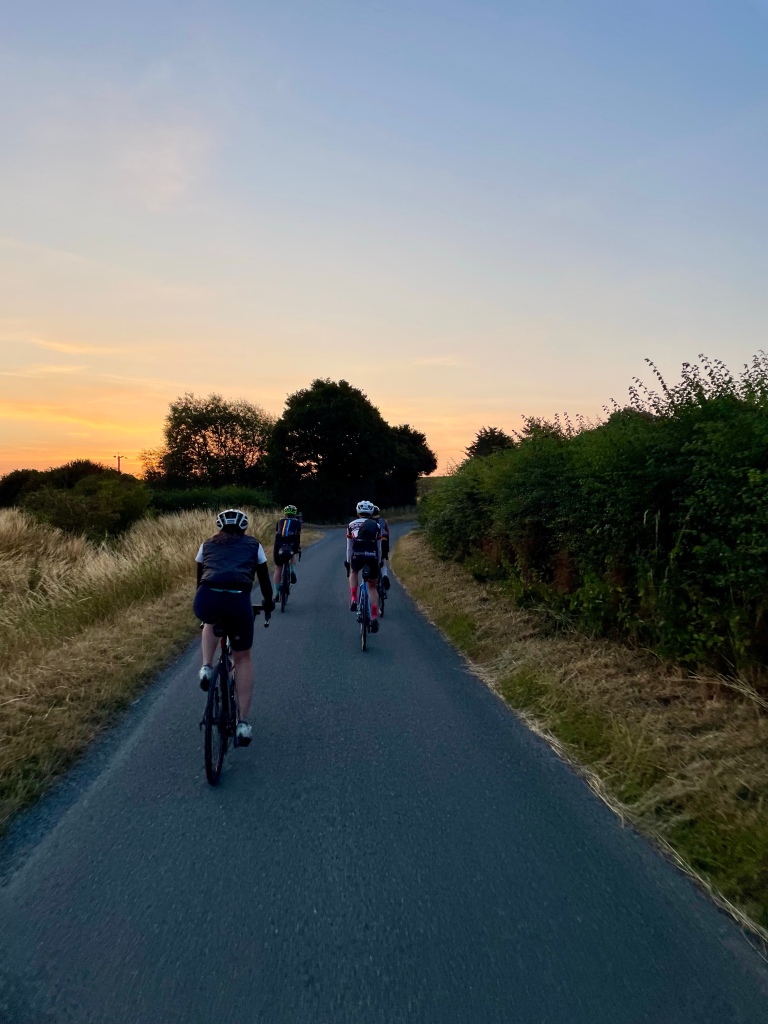
Our little team of eight moves like a dream through the little villages of Essex, faster than any of us expected; we’re driven on, dedicated to the route, all of us brought together for one night for the same miles, the same turns. Some of us have done it before, some haven’t. The route is the same as years gone by, but the rest stops shift around, and we swap tips about where the good coffee is, and whether the Fire Station will be raising money and selling BBQ. We stop often, sharing kit kats and pork pies, enjoying hot drinks in styrofoam cups, huge numbers of cyclists streaming into each stop just as we depart. A yellow gibbous moon watches eerily, and even as late as 1am, people sit in their front gardens, watching this weird unsleeping peloton roll through. They know: in the dark quiet of the dark night we are coming, following the scent of the dawn.
The sun starts early – I think it’s 3.30am when we see the first crack of sunlight, and an hour or so later the whole horizon has a light under it. Bats and moths and then all of a sudden, we don’t need our lights. Here we all are, tired, wired from the caffeine and energy gels, spinning through a gorgeous morning, no cars on the roads, the countryside yellow and green, half burnt, half verdant. The start of the day feels perfect, then hard, my legs are beginning to lose it, and the last 20 miles feel lumpy – and then “Dunwich 7” appears on the road signs – and we accelerate, and you can see sand at the edges of the road.
Then, the cafe and the beach, a steep pile of shingles and the cool swish of the sea. There are cyclists everywhere, some with sleeping bags and camping mats, others just curled up around their bikes. Some of them have got to the queue for the beers and fry-ups. Half the Peckham crew change into swimsuits and race for the sea (pro tip: bring a change of shoes, the beach is not kind to cleats). I just take off my shoes and dig my feet into the sand. We made it. We queue, a lot – for slots on the bus home, for carbs and drinks – and then we sit and laze around, looking at Strava, looking out to sea, amazed at what we just did.
It’s a three hour drive to London – I sleep half the way and wake up, somehow surprised and then proud that we came such a long way – and we hang around waiting for the bikes to be unloaded because we put ours in first, and they’re at the back of the lorry. We’re all exhausted, but you can’t help but still feel slightly elated.
As they unload the bikes, the removal team hold up a big steel bike with white wall tyres. “Raspberry Red Pashley!” they call out, and the assembled cyclists cheer and clap as its rider reclaims her ride. We all made it and it made sense at the time. The Dynamo is a midsummer night’s dream, where it’s all the more powerful being inside a mystery, even when you don’t fully understand it.
One of the many things the pandemic dislocated is the start and the end of the year. What even were January and February 2020? A forgotten prelude, unconnected to the real 2020, which began when we went home from the office in March. When the shops and the schools closed shortly after. When the sun started shining. And when did it end and begin again? Not at Christmas, because straight afterwards, the schools and the shops closed again. Perhaps it ended a few weeks back, with my first vaccination, a moment of grace in the gloved hands of a nurse, followed by 24 hours of lethargy, jetlag head, and the dull ache of societal grief washing through my bones.
Maybe the end is roundabout now, a year and a bit after we went home, a year after I wrote in an email:
The weather is cold, a sharp Spring cold. The schools have only been closed a week, somehow. I found spaghetti, rice and a small can of baking powder yesterday and it doesn’t feel odd to record that. How is it still March? All of life has been blown away.
I read more books than usual this year, the average quality level was higher and there are two or three that I would press in to your hand right now. It was altogether, the most enjoyable year in reading for a while. What I took from this is a good reminder that beneficial effects are often linked – more and better, faster and together, quality and quantity. This is frustrating when you’re focussed on change, because it’s easier (and more desirable) to be able to isolate single pieces of the system and operate on those, and it’s more pleasant to believe that operating on isolated parts of the system can drive holistic change – more pleasant because that’s clearly easier than the alternative, which is to accept that changing systems requires a look at the multiple interrelated pieces that comprise the whole.
How to read more books Counter-intuitively though, it can sometimes be straightforward to jumpstart some level of change with a small, meaningful action. In this case, for me, it was just to really focus on reading over the summer, and to shorten the time between buying and reading a book. Over the last few years, I’ve bought books by building an order from end-of-year “best of” lists, and then buying a large number from Amazon, in order to have good choices of books on hand the moment I finish one. The difficulty is that culture goes cold, that is to say, something bought in December can look less interesting in March. Throughout last year, I consciously shortened the distance between buying and reading, which meant I got to Jia Tolentino’s excellent Trick Mirror, Paul Kingsnorth’s Savage Gods and Max Porter’s Lanny quickly. All three are worth your time.
I used to look for patterns in the books I read, as though each book was itself a chapter in another book, one that would tell the story of the year. But honestly, who would make up the story of last year? Not the news, but my own story, where I had my second son and lost my mother to cancer in the same month.
That being the story — less an arc and more a downpour, less a journey and more an explosion, less a beginning/middle/end and more a big bang and black hole — the books ought to reflect things like faith and fatherhood, or grief and growth. There’s a little bit of that, because there’s a little bit of that in so many stories, but 2018’s reading was really just a jumble of fiction and non-fiction, and I am not sure there is any great lesson in it.
I’ve been working – or at the very least, sitting at various desks, typing – for about 18 years. Before I had a career, I thought what I would do was write literature, or at the very least, serviceable novels. Then I spent a few years as a technology journalist, and another few as an editor. By the time I was 30 that had plateaued. I’ve worked in Product Management for nearly a decade since then, and I’ve actually been fairly successful. I lead a great team, and the product we work on reaches hundreds of millions of people.
But I’m not sure “Product Management” is really the thing I am good at. For starters, it’s not a specific, single thing, and for seconds, it’s such an early 21st century role that it may well disappear or certainly change radically over the next 20 years, to the point that it won’t make any sense to look back and say “I was good at that,” because that will not be there any more.
So what have I become good at over the course of working for nearly two decades? What skills have I developed?
Itis fairly common in England to see small plaques set into the front of older houses with chiselled numbers saying when they were built. 1906, 1871, 1832. In Cartmel, a little village at the southern tip of the Lake District, home of a couple of very good restaurants, there’s a little whitewashed stone cottage, and in black paint above the door, the date of its construction: 1776.
At the same time as the Declaration of Independence was being signed in North America, under the cloudy skies of Northern England, somebody built this small house, putting stone after stone on top of each other to fashion solid, rough walls with their backs to the rising hills.
People still argue over America’s founding ideals; they wonder if those ideals make sense still. The white house in Cartmel still makes perfect sense today. It is lived in, wired up for power, water and wifi and worth hundreds of thousands of pounds. So it functions just as you’d expect any brand new house to function: as a home, as an asset and as a node on the network.
For some reason, I have no photos of this house, even though I can picture it exactly. I remember having this thought, too — about it being built at such an interesting point in history — as we walked past, and I didn’t tweet it. My little interaction with it is gone, but no matter. The next person to go past doesn’t need any written clues from me. They know what the little house is for.
I’ve had trouble sorting out what I read last year. The books themselves aren’t sorted. We moved in November – so they’re still all piled up in the corners of the house, like snowdrifts. Paperbacks I’ve not seen for a decade or more are sitting right at eye level, while my copy of one of the best things I read in the last few months, Lincoln in the Bardo, has disappeared without trace.
So I’ve only got the list I made to tell me what I read, and it strikes me as completely all over the place. If anything the list itself is an output – a trial of four ways of discovering things to read:
Podcasts & social media recommendations.
Big new releases, often reviewed or talked about in traditional media.
Things about current trends.
Stuff that “found me” – presents and books I’d bought months or years previously and that sat around until some moment caused me to start them.
Each of them generated one really good recommendation and lots of duds. The good ones were good in different ways; the bad ones, too.
On the occasion of the Rolling Stones’ 30 year anniversary, a journalist asked laconic drummer Charlie Watts, “what had it been like to spend three decades working with the band?”
“Five years of hard work,” he replied. “And 25 years of hangin’ around.”
Now Charlie Watts put the slink into Sympathy for the Devil and the pop into Satisfaction, so you can forgive a man a lot of hanging around when that’s what happens when he’s working. But if, in your next monthly catch up with your manager you announced you’d replicated this productivity ratio in the office – five days of hard work, 25 spent “hangin’ around” – you would likely be facing some tough questions. For all that digital leaders talk about outcomes not output, there is an invisible standard, a sort of “I know it when I see it” quality to what counts as being productive.
Most of us have internalised the fact there is no time for hanging around. Most productivity methods – Agile, Getting Things Done, Bullet Journals – have their things to say about “value” and “focus”, but the answers, the process, and the meat of what they’re about is basically throughput.
Make a list. Process it in some way, into categories. Get through it. Put a lot of ticks next to a lot of things.
Early in the summer last year, we went on holiday to the south of France. The lanes around the house smelled of lavender and olives. We ate outside on the veranda, looking out over wooded hills, the day’s dry heat like smoke in the air.
There was a swimming pool, a neat Topaz jewel, the same bright blue colour as the sky. Sadly my toddler son decided to hate it – he would sit on the edge and kick his little pink legs to paddle but if he got in deeper than his waist he would scream and cry in rage.
A few weeks later, at the end of the summer, in a hotel in Scotland, the same boy was very different. Again and again, he sat on the lip of the edge of the pool, grinning and bouncing, before pushing himself to fall toward, into the water and into my arms. Something had changed, and he was ready for the world. Now we try and go swimming every other weekend to the local pool. The first time we went, as we got changed, I took off my watch and my shoes and my socks and I remembered how when my father took my brother and I swimming as kids, he used to push his watch into one of the shoes before putting them into the locker. The carefulness of that action came back so strongly, even though I never knew I remembered it.
This year’s best books weren’t about character, but about the context of the past.



 The Wired Jester