The cover of a magazine called Home Farmer, which I spotted while out and about at the weekend. I spend quite a lot of time looking at other magazine’s covers, and this one was quite something – brilliant use of a question even regular readers might not be thinking of asking themselves.

Pet Sounds, a capella
It’s a beautiful sunny morning in London, so this seems like just the right thing to listen to: Pet Sounds, a capella. Despite the fact that it’s a YouTube link, sound quality is terrific. This is probably the first time I’ve really understood just how spine-tingling what music writers refer to as a singer’s ‘phrasing’ can be – check out God Only Knows. Particularly stunning is when the harmonies simply ends, and one of the group says in a very normal voice, ‘how was that?’
Apparently, the original source is a box set called The Pet Sounds Sessions
Wikipedia’s entry on a capella singing is interesting, relating “a cappella music originally was, and still often is, used in religious music” and that the use of instruments was a matter of debate in the early Christian church.
Year of the Ox’s most popular internet slang
FAIL is over – especially if you’re in China. Apparently, these are the Year of the Ox’s most popular linguistic terms on the internet (although we’re only halfway through the year). Wonder how long it will take for ‘yùzháizú’ – the Chinese word for otaku – to appear in Wired or the new William Gibson novel?
Favourite term: FB = 腐败 = fǔbài. Originally the corruption of government officials, now commonly used to refer to going out to have a nice meal. Oddly close to fubar.
(via @monglor)
Arthur Ransome and Communism
Another English writer who was in bed with the Bolsheviks? Literally, in the case of Arthur Ransome. He was a journalist in Moscow in the early 20th century, and his lover was Trotsky’s press secretary. A new biography of Ransome (best known for his children’s books such as Swallows and Amazons) focusses on the time he spent reporting in Russia in the early 20th century and his links with the Bolsheviks:
Between 1917 and 1924, as Russian correspondent for the Daily News and Manchester Guardian, he was an uncritical apologist for the Bolshevik regime, with unique access to the revolutionary leaders. As the Red Army engaged with an Allied invasion of Russia, Ransome was conducting a love affair with Evgenia Shelepina, private secretary to Leon Trotsky, then Soviet Commissar for War. As the intimate friend of Karl Radek, the Bolshevik Chief of Propaganda, he denied the Red Terror and compared Lenin to Oliver Cromwell. No English journalist was considered more controversial, or more damaging to British security. At Whitehall, he was accused of being the paid agent of a hostile power and only narrowly escaped prosecution for treason.
I caught the author of The Last Englishman: The Double Life of Arthur Ransome, Roland Chambers, on Radio 4’s Open Book this afternoon. It’s well worth a listen again – especially the entertaining tail of Ransome leaving Russia for Sweden in a Bolshevik’s uniform carrying a diplomatic passport and millions or roubles in a satchel. I loved Swallows & Amazons when I was younger; quite cool to think that it was hiding revolutionary ideas…
Update: I posted this story to Metafilter, and there’s some interesting discussion there in the comments.
International Times
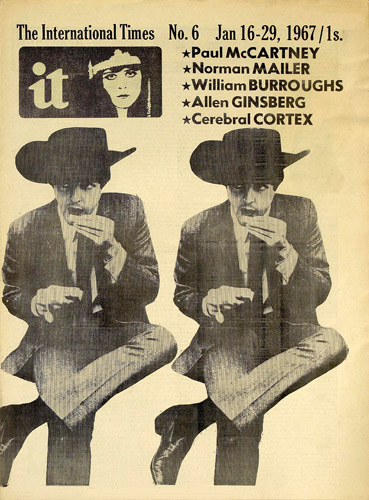
The Guardian has a blog post up today reflecting on the radical/hippy/underground 60s newspaper The International Times, as an archive devoted to IT has just launched (although said archive appears to be down at the moment). Anyway, the Guardian blog quotes some notes I took at a talk by the founders of IT, which you can read in full here on The Wired Jester. There’s also a selection of scanned covers and pages to look through.
The cover of 1984 (updated)
“The typescript of George Orwell’s latest novel reached London in mid December, as promised. Warburg recognised its qualities at once (“amongst the most terrifying books I have ever read”) and so did his colleagues. An in-house memo noted “if we can’t sell 15 to 20 thousand copies we ought to be shot”.
– From the Guardian’s look back at 1984, the “Masterpiece that killed George Orwell”.
1984 is no longer the book that’s most influential on me, or my favourite, but it is still a part of who I am – like a literary tattoo. I read it at just the right age and the right place – a wordy 17 year old at college in Luton, obsessed with books and how they describe the world – and I’ve got some beautiful copies of it at home (including a beautiful illustrated one) as mementos. Penguin recently posted up a competition on Twitter to win a signed print of the Shephard Fairey image adorning the the current 1984; you had to come up with an image Penguin’s publicist can use on his Twitter page that reflects the book. I pulled two contenders from my Flickr account:

It’s a shot of the Colossus computer at Bletchley Park. I liked the flatness of the colours, the lack of shadows, and the suggestion of words being monitored. And also, of course, the reference to “the commons”. In the end though, I went for this one:

A favourite of mine, snapped on the iPhone at Tate’s Rothko show. I think it’s funnier and stranger than a lot of 1984-derived images tend to be; of course, it doesn’t shy away from the central darkness of the novel, of how bleak life is when words cannot be trusted.
Update: I won!
New Flash Hack

This post from a while back on a flash hack for the Nikon D40 has been one of my most popular pieces here, but sadly the original images it linked to are long since gone. Today I found this article over at Instructables which is just as good – in fact, because it uses the foil of a cigarette packet to act as the flash difuser, instead of just cardboard, it’s probably even better. Read the full how to here.
A trip to Taipei, Taiwan
Not a place many people visit, but I’d agree with Rough Guide when they call Taipei Asia’s most under-rated city. It’s where the IT press go every year for Computex; I’ve been there three years (2006, 2007, and this year). Here’s some photos not of motherboards or netbooks, but of the place where they’re born.

Close-up detail of a painted door, temple, Taipei.

Businessmen praying before work. Incense burns, and people rub the smoke into their clothes for good luck. This was taken at Longshan temple, one of Taipei’s busiest.
Continue reading “A trip to Taipei, Taiwan”
Computex 2009
I was in the Far East all last week, first to Taiwan to report on the Computex trade show. We filed tons of stories on bit-tech (full list) and I also contributed a quick, more mainstream write-up for the BBC website. On the way back, I went via Hong Kong to visit an old friend, and rather serendipitously, arrived on the 4th of June, the 20th anniversary of the 1989 Tiananmen Square protests. I took plenty of photos, which I’ll post up once I’m over the jetlag.
Flickr Superstars
A post on the Flickr blog got me thinking about my 12 ‘Flickr Superstars’. As I made my notes, several themes emerged:
i. The Far East, specifically Japan. Having visited the Far East specifically, and having a Japanese fiancee, it’s no surprise that I’m fascinated by Japan, and I think there’s also a sense of me trying to understand it – culture, people, places, feelings – through images.
ii. Fast lenses. Quite a few of my favourite Flickr images rely on fast lenses (f1.8 and below).
iii. Simple, strong, compositions. If you look in the group devoted to these lists of 12, a lot of the photographers suggested are ‘high concept’. Lots of PhotoShop, and self-consciously arty compositions. Not for me – as with film, music (where I’m a big fan of 80s and early 90s alternative US groups such as The Replacements, Pixies, Nirvana), I tend towards images which are more strongly rooted in reality.
My favourite 12 are after the jump.
 The Wired Jester