Domains of the strange, mad and sad

Mass Games
Mass games, Pyongyang. Photo: Lawrence Hudson.

1984 was one of the first novels I read that really grabbed me: I hit it at just the right age and at just the right time of year – a quiet teenager holding the book in a blowy spring that was full of bright cold days and people buttoned down into their coats, with pale, fluorescent-light skin. Ever since finishing it, stories about mad, crazy despotic regimes have always interested me – both for the tales of the audacious lunatics who usually run the show, and also for the insights of what it’s like for people to live in a country run by leaders who consult astrologers, spend all the cash on gold plated palaces and think nothing of training thousands of school kids to display coloured placards in sync so you can spell out your name.

No discussion of bleak, barmy regimes would be complete without a mention of North Korea, a place which my friend Lawrence recently went to as part of his travels in Asia. He’s posted about the trip, on his blog, here. Meanwhile, Burma has been in the news more recently: the Times had a good piece up on Naypyidaw, the random, completely new capital the Junta recently constructed. Also worth reading is a blogger’s take on his trip to the new Burmese captial, complete with pictures.

Digg and the art of the headline

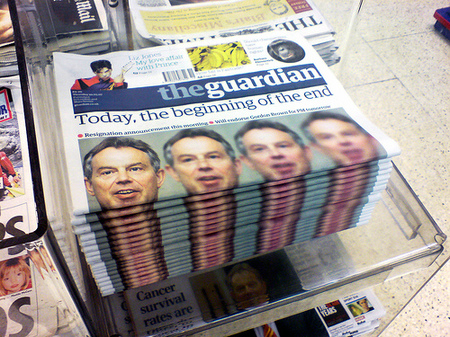
Tony resigns

[The entry has been cross posted from my work blog]

When it comes to the web, there really aren’t many ways in which to gain readers for your site. Not that many practical and legal ones, anyway – sure, I could pay a dodgy bunch of Eastern European types to knock up a virus that sets everyone’s homepage to custompc.co.uk, and I could hire a team of skywriters to put our name above London.

Increasing readership online is fairly similar to increasing readership of a magazine in real life – although at first glance this isn’t the case. The New York Times has run stories about how search engines are changing the dark art of writing newspaper headlines. Instead of witty puns, the story goes, the importance of appearing high up the Google rankings means simplicity is more important. There is a truth to this: Google drives a lot of traffic, and while humans will understand a punning, tabloid style headine when they see it on the page, when people Google, they Google in simple, explanatory language. The headline in the picture above is a good example: I know it’s about Tony Blair’s resignation announcement, but if I was searching for that story online, I wouldn’t necessarily Google “beginning of the end.”

However, while Googlers prize simplicity, the art of headline writing lives on: submit a story to online news aggregators such as Digg or Slashdot, or even to one of the big blogs such as Engadget, and you tend to find that plainly worded stories die an obscure death – unless of course, the story itself, even worded plainly, is powerful enough to draw people in. I don’t think you’ll find anyone going through these sites extolling the virtues of the headlines in the way people do for the Economist or the Sun, because I don’t think the bulk of the submitters to Digg and Slashdot have honed their skills in the way sub-editors on big publications do; but the big stories on these websites do tap into their audiences’ interests in the same way ‘Gotcha’ et al engaged the Sun’s readers in the 80s.

The reason headline writing is still important on the web is that increasing readership in the online world, as in the offline world, basically comes down to increasing visibility and word of mouth. A good headline – which is both hook and synopsis for a story – does both. It pulls the reader in (visibility) and by reducing it to a soundbit, makes it easy to share (word of mouth).

That said, while headlines are important for getting noticed on sites such as Digg, there are a lot of other considerations which go into why a story makes it big or dies. Some of them tally with media experience in the real world. Stories on Digg stand a much better chance if they have a well-known source – large US sites such as Engadget, Gizmodo and mainstream media titles such as the New York Times contribute a lot – and stories will do better when they’re back by a well known digger. Case in point, our “10 Hardest Games” feature. I submitted it and garnered a woeful 4 Diggs; almost exactly 24 hours later, another Digger submitted it using very similar langauge, and it attracted 1,234 Diggs. To some extent, this mirrors what happens in print – if the Daily Telegraph prints a story, people will pay it more attention than if it appears in Bedfordshire on Sunday.

The audience on Digg is, despite the site’s efforts to expand its topics of conversation, generally very focussed, too: iPhone stories, Ubuntu plugs, anti-RIAA pieces pop up time and time again; but likewise in print, successful titles learn what their audience is interested in and generally tap into that.

And yet all this reasonable talk, is little consolation for the fact that so few people Digg our stories – or at least the ones we ourselves submit. Perhaps it’s just the case that we just need to get Custom PC more – tough, I think, because there are no shortage of tech sites out there (although most are a load of cobblers), because there’s a US-bias to the Digg, and because there’s always something that looks obscure and dull to me that’s hoovering up all the Diggs.

Still, we need to persevere I guess. If you fancy helping out, add me as a friend on Digg 😀

An online notebook

Notebooks

As I mentioned a couple of days ago, I stopped link-blogging on this site – as I was using Delicious, everything I ever saved was getting posted here, which was both ugly and lazy. Delicious certainly had its plus points though; regular blogging is good, and using it made me think about the links I was saving. Ultimately, though, the form and the function didn’t quite work.

I’ve been thinking about what to do with this site quite a bit, and one of the things which has occurred to me is how much I like keeping notebooks in the real world – you can see a big pile of the last few years’ worth above – and that if I could find a web app that was similar, I’d be very happy. As a result, I started experimenting with Tumblr. It’s yet another linguistic crime of a name, but the actual program is very nifty; a lightweight, easy to use, and simple blogging app made for handling links, videos and pictures.

Best of all however, is the way in which it handles quotes. Tumblr has a specific way of dealing with little pieces of text, which fits very well with my current thinking on what I’m going to use the main blog for next. There are a lot of design-influenced tech blogs, but far fewer that look at text, writing and reading and how they intersect with technology

But I’m getting ahead of myself… For the moment, behold The Wired Jester’s Jumps & Tumbles, a companion link-log / web scrapbook to this main blog.

Pownce invites up for grabs

Pownce Cat

A cat, ready to pounce, yesterday.

Just a short post; I’ve signed up to Pownce, the Twitter knock-off/second coming from, among others, Kevin Rose of Digg. The best thing about it is there’s a lot of vowels in the name compared to most Web 2.0 sites, but I’ve not used it that much yet.

Anyway, as a result of getting in, I have six Pownce invites available, so they’re up for grabs to you, my loyal, bribeable readers. Whereas my Joost invite give-away was first come, first served, this time, there will be an element of skill involved. Leave a comment on this post and add the name of your favourite pouncing animal, and the good ones will get invites.

There will be more, but before that, less

A couple of weeks ago, I mentioned that I was considering making some changes to this blog. I’ve begun the tinkering; a lot of it has, so far, been behind the scenes, and has mostly consisted of doodles on paper, but some of these ideas are now going from the real world to this digital one. Most noticeably, I’ve unhooked the Delicious feed so there won’t be any more daily link posts. Although it’s nice and convenient, I always thought they looked ugly and mundane posts such as this one illustrated the system’s lack of flexibility – you have no control over what gets posted, so anything saved to Delicious is publicised.

Delicious link posting is very easy, but doing something because it’s easy is not really what I’m interested in. It needs to be good, or it needs to disappear. So begone, idle links.

And in their place? Well, the site is going to have a tighter focus. So more photos, more writing, but perhaps less frequently than before. I’ve been out and about a lot this summer and bought a house, so there’s been a lot going on behind the scenes of the behind the scenes of this blog…

links for 2007-08-23

links for 2007-08-22

links for 2007-08-21

The Wired Jester 2.0

London Bridge

Picture caption: The road to the future, yesterday. Lots of concrete and white light. No robots in sight.

It’s been a while since there’s been a longer post on the Wired Jester, so I thought I’d drop one in, partly because I’m quite proud of the above shot at London Bridge and wanted to show it off, and partly because I have genuinely been thinking about what to do with this site going forward. At the moment, I’m enjoying the link blogging – it’s quick, light and easy, and it fits in well with all the DIY I’ve been doing in my spare time in new house, but I have got a new idea for the Jester that will hopefully see it getting a little more use than just as a link repository. As ever, it’s just a matter of finding the time and figuring out priorities…