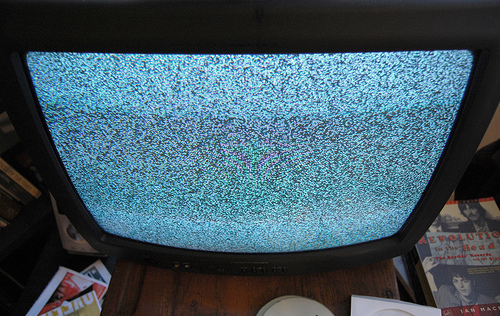
IPTV’s biggest problem

Dead channel

IPTV, or to give it a name rather than an acronym, TV over the web, is currently a very hot topic – whether it’s industry / IP clashes (of which this is just the latest in what will certainly be a long and tedious series of legal maneuvers) or technology ideas like Joost, a lot of people are taking TV on the computer very seriously. As well they should. Who doesn’t love the idea of getting good TV when and where they want it, and on whatever device/viewing platform they prefer? Who doesn’t think there’s money to be made, cool new technology to be invented and fun to be had with it?

But.

There’s always a but. There is one problem which hasn’t been considered.

IPTV will ruin the best opening line of a novel in the last 30 years.

The novel is William Gibson’s Neuromancer, and this is how it begins:

‘The sky above the port was the color of television, tuned to a dead channel.’

It’s a brilliant opening: both gripping and detached, strange technical but still immediate and crucially for any description, tangible to the point that it has real emotion. A good opening line like this is like a good part of a pop song: a guitar crunch, a bass drum thump, a chord: it’s a moment that pulls itself out of normal time, a second that lasts longer than every other and acts as portal into what will follow.

IPTV has no static. In twenty years time, copies of Neuromancer are going to have a little 1 at the end of that line and young readers will immediately stop, flick to the notes at the bottom, and see a long, overly explanatory note that says “TVs used to get a signal through an aerial. When they were not tuned properly, they would display static, a strange commingling of white and black pixels. Gibson uses this image to immediately foreground a feeling of emotional deadness, of disconnection, of blah blah blah etc etc”

You get the picture (no pun intended). So, developers of IPTV – please put static in! At least as a little option. It could just pop up every now and then. Hello? Please!

Nikon D40: A couple of weeks in, time for some ‘terrific honesty’

My_eye

So I’ve had my Nikon D40, complete with kit lens (18-55mm) for a couple of weeks now – my first SLR and a choice that I arrived at after some fairly protracted hand-wringing. How has it worked out? Brilliantly, to be honest – considering I’ve basically just taken it out and about in London, I’m really pleased with the results I’ve got so soon in. ‘Terrific honesty’ in my eyes was one nice comment – any guesses what I’m saying in the shot above?

The fact the kit lens goes to a relatively wide angle setting means you can get some really creative shots, too:

Spiral Vertigo
Library Parabola

Having a bigger lens and bigger, better CCD than a PnS camera means you capture so much more light, and the pictures are correspondingly better – richer, more detail packed without you having to whack the saturation up or tinker with the levels in PhotoShop. I’ve done a lot better on Flickr, too (yeah yeah, I know it’s not a competition) but even so, I’m quite pleased – and I got picked for the Photojojo newsletter from this week, so I’m clearly becoming a better photographer, which is what I was aiming for.

One point I would make is that while Ken Rockwell has his fair share of detractors, his D40 set up guide is excellent – far better than the manual, and a good no nonsense walk through of the menus and the various options. Well worth checking out if you’ve just got a D40.

Questions about the flannel panel

While it’s well known that computers have a tendency to iteratively generate linguistic geekery – acronyms, memes, slang – magazines also have their own weird and wonderful dialect. In the English-Magazine dictionary, a ‘flannel panel‘ is basically the team sheet for a magazine. It lists who works on the mag, their job titles, contact details, as well as the magazine’s address, and usually some legal information such as copyright and disclaimers.

We’ve recently added a ‘question of the month’ to the Custom PC flannel panel as a fun little Easter Egg for attentive/bored/obsessive readers; it seemed like a good idea at the time, but now we need to think of a question. January’s one posed the very obvious "New Year’s Resolution?" question, but today we had a brief brainstorm about some possible qs for the future. Here are my suggestions:

“What’s your problem?”
“If you could only eat one thing for the rest of your life, what would it be?”
"What do you wish you knew more about?"
“In an ideal world, who or what would your voice sound like?”
“In the movie of your life, who would play your nemesis?”
“What band would you like to see reform?”
“What gig do you wish you could have been present at?”
“Let’s assume a sorcerer is going to change you into an animal but he gives you a choice as to what you could be turned into. What animal would you pick?”
“What criminal behaviour should be legalised?”
“What should be a criminal offense?”
“Given the power, what technology would you un-invent?”
“What super power would you pick, given the choice?”
“If you could be in charge of any country in the world, which would you pick?”
“What’s your ideal breakfast?”

Feel free to add your answers or let me know some of your own flannel panel questions…

Bad predictions: storms, world to end

Crazyweather_1

The weather continues to frustrate my plans to get out and about with my new Nikon D40 – or rather, the weather forecast does, since every day it predicts terrible storms and then by lunch time it’s sunny but my new camera is stuck at home. So in the evenings I’ve been experimenting with some macro stuff, resulting in a few thrilling shots of mustard. Don’t all rush to see them at once. Still, as you can see from the above, Yahoo’s front page is predicting doomsday, so perhaps an unused camera is the least of our troubles. However, a picture I shot with the old point-n-shoot Pentax has been posted up at Plastic Bamboo, an enjoyable blog on Japan and technology, which is nice 🙂

I For One Welcome Our New SLR Overlords


  I For One Welcome Our New SLR Overlords 
  Originally uploaded by Sifter.

My Nikon D40 is here! Under £400 from Walters Photo & Video (arrived very quickly, excellent service), plus a 2GB memory card for £20 from Crucial (again, top notch service). Now I just need to learn to use the thing – here’s hoping for some sunny weekends ahead so I can get some practice in 🙂

The Digital SLR Camera Conundrum

Ever since I started using Flickr and got my own digital camera, I’ve been getting more and more into photography. It might be the competitive impulse that Flickr’s well documented game-like elements introduce (Flickr originally began life as a game called Game Never Ending), or the fact that once you’ve got a digital camera and a PC, if you put in the time, there’s a steady learning curve, and you can literally see how you progress. And of course, since I live in London I’m never short of subjects to shoot.

I’ve had my digital camera, a point and shoot Pentax Optio S5i, for over two years now, and for a while, I’ve wanted a digital SLR, so that I can learn some new things. I am not the only one though – there’s a growing market for first-timer dSLRs, and for slightly pricier "pro-sumer" models. The problem then, is choice. I’ve finally made mine, and thought it might be useful for people looking for their first SLR to know why I went for what I did.

The choices were:
* Canon EOS 400D (aka Digital Rebel XTi). This costs about £500, and it follows the very successful EOS 350D. I’ve seen several people on Flickr get really excellent results with the 350D, but for me, a couple of things ruled the 400D out. Firstly, the kit lens is not highly thought of. Well, actually, it’s crap. I went into Calumet in Soho and the assistant told me it wasn’t even worth using, and I’ve seen similar complaints online. I didn’t want to be stuck with a camera where within a few months I’d be needing to research and buy a new lens. Secondly, a lot of people, both users and reviewers, have complained it’s a little too small for its own good.

* Nikon D80. Undoubtedly the best camera of the ones I considered – it enjoys pretty much universal press acclaim, with everyone from net sites to DPReview to colleagues of mine at PC Pro raving about it. The only problem is that with the excellent 18-70mm kit lens it costs at least £700. This is a lot of money for a first time dSLR, and it’s more than I have right now.

* More exotic choices – the Sony Alpha A100 and Pentax K100 and K10. The Sony is very keenly priced for a 10 megapixel camera, and has some neat technical tricks like a dust filter and super steady-shot features. It’s also fared well among reviewers, especially a recent write up on Anandtech. I ruled it out because it has the most limited lens choice and Sony kit can be a bit flimsy. The Pentaxes were attractive because I’ve had good experiences with their kit – my point-n-shoot is a Pentax – but the K10 is pretty much the same price as the Nikon D80 and the K100 didn’t fare as well in a DPReview head to head with the camera I did end up chosing…

The Nikon D40. This is the newest of the cameras here, and at just under £400, it’s not too pricey. Its 18-55mm kit lens enjoys a much better rep than the Canon’s, as do the camera’s ergonomics. The only downside is that the D40 has no built in motor with which to auto-focus – it relies on the lens’s, so this obviously limits the lenses you can use (only AF-S ones) – however, I don’t have any lenses so I can make sure ones I buy will work with the camera. Worst case scenario is that I have to manual focus them. Ultimately, I didn’t think it was worth paying the extra £300 for a D80 over the D40, especially for a dSLR novice like myself. Pro photographers like Ken Rockwell speak very highly of it, too (his excellent write up is well worth a look, esp if you want a more considered look at the lens issue), and the photos other Flickr users have got from it look tremendous.

So that’s why I’ve ordered the D40 and a 2GB SD card; it’ll be in my grubby little mitts on Tuesday apparently, and I’m already far too excited 🙂

Books I’ve Read, 2007

Every year starts off as a journey (and ends as an uphill battle), so in the spirit of setting out on a quest, I’ve started 2007’s reading off with a travel book, all about Iran – sure to be a country on our minds this coming year. As ever, I’ll update the list with the books I’m reading, and try to add a few words and some decent quotes from their pages, too.

Previously: Books from 2005 and 2006.

1st January – 20th January. Mirrors of the Unseen: Journeys in Iran, Jason Elliot.
10th January. The Glass Books of the Dream Eaters (Installment 10), G. W. Dahlquist. (my full review, here).
20th January – 6th February. Specimen Days, Michael Cunningham.
7th February – 9th February. The Perfect Thing, Steven Levy.
9th February – Present. The Writer’s Journey, Christopher Vogler.
24th February – 10th June, 2008. Don Quixote, Miguel De Cervantes (translation by Edith Grossman).
28th February – 2nd March. Buddha: Volume 2, Osama Tezuka.
3rd March – 8th March. Buddha: Volume 3, Osama Tezuka.
9th March – 15th March. Buddha: Volume 4, Osama Tezuka.
16th March – 19th March. 33 1/3rd: Let It Be, Steve Matteo.
20th March – 2nd April. Girlfriend in a Coma, Douglas Coupland.
3rd April – 8th April. Buddha: Volume 5, Osama Tezuka.
9th April – 11th April. Buddha: Volume 6, Osama Tezuka.
12th April – 28th April. Black Swan Green, David Mitchell.
28th April – 7th May. The Long Tail, Chris Anderson.
8th May – 17th May. The Player of Games, Iain M. Banks.
18th May – 16th July. Madame Bovary, Gustave Flaubert
15th June – 10th July. Bad Elements, Ian Buruma
21st June – 10th July. Invisible Cities, Italo Calvino.
17th July – 12th August. The Recording Angel, Evan Eisenberg.
13th August – 3rd September. Spook Country, William Gibson.
4th September – 26th September. Getting Things Done, David Allen.
27th September – 11th October. Extremely Loud & Incredibly Close, Jonathan Safran Foer.
12th October – 26th October. Tokyo Year Zero, David Peace.
27th October – January 17th. Crime and Punishment, Fyodor Dostoevsky.

Fantasy New Year’s Eve Party

Red Lamps

Gather round…

Philosophical journalist (Pop Philosopher? Celebrity Proust Fan? Oh, I don’t know) Writer Alain de Botton has a quick little post up on the Guardian’s Arts blog called ‘My Fantasy New Year’s Eve‘ where he picks out his ideal guests for NYE. Even better than Alain’s picks (Proust, Keira Knightley) are the comments:

"My ideal dinner guests would include Jonathan Ross, Catherine Tate,
Jade Goody, Pete Doherty, Posh Spice, Paris Hilton, and Dawn French.
Once they were all safely seated, I would make my excuses, leave the
building, and call in an air strike."

My own fantasy NYE list? In addition to friends and family, of course – it would be nice to unite my scattered tribe – I’d love some time to chat, drink and play Guitar Hero with the following… (all of them still alive, because if you’re going to go around collection dead people, you’re never gonna beat Bill n Ted):

John Squire

Slash
(Both fairly obvious really – I’m massively into Guitar Hero at the moment, so having two top guitarists on the list would make for some fun)

Gordon Bown (Hey, it makes sense to get in with the new boss!)

Hayao Miyazaki (Japan’s greatest living director. Need to convince him to make a movie of the novel I haven’t yet written, because he keeps threatening to retire. From the documentaries I’ve seen about him and his studio, he looks to be a fairly entertaining, if slightly cantankerous guy)

Mamoru Oshii (Director of both of the Ghost in the Shell movies, in interviews he’s fabulously uncompromising and challenging, particularly on the subject of humans, robots and AI)

David Mitchell (My favourite author. Would only be invited if I could control my jealousy.)

Chris Anderson (Wired editor. He’s an entertaining speaker – I saw him at the London launch of his Long Tail book – and who better to talk to about technology and magazines?)

Penguin’s new media/digital/technology team (Of all the big publishers, they seem to have been doing the best when it comes to the opportunities of new technology – I’m a big fan of their blog, of the Glass Books and their various other experiments online)

Aaron Sorkin and Thomas Schlamme (Creators of the West Wing, creators of superb drama and characters)

Courtney Love (She can come across as eminently hateable, but then you remember ‘Live Through This’; I’d love to talk to her face to face, see what she’s really like)

Richard Holmes (Biographer, writer. my ex-tutor at UEA, he was consistently thought-provoking and inspiring: "Everyone needs to talk about their own past, the forces and experiences that shaped them, and how rarely this constant need is satisfied in the competetive, pressurised world, except in moments of emotional crisis." – Footsteps, p207/8)

Nigel Slater (His cook books are great, and he’s an excellent writer, too)

Sir Howard Stringer (Head of Sony. Someone needs to ask him what the hell is going on what with that firm and tell him to make the most of the chance he’s got)

Will Wright (Creator of Sim City and the Sims, he’s an eloquent and thought provoking speaker: "The human imagination is an amazing thing. As
children, we spend much of our time in imaginary worlds, substituting
toys and make-believe for the real surroundings that we are just
beginning to explore and understand. As we play, we learn. And as we
grow, our play gets more complicated. We add rules and goals. The
result is something we call games.")

Stewart Butterfield and Caterina Fake (Founders of Flickr, the website that has, after Yahoo Mail, become the biggest online part of my real life)

Happy New Year everyone!

Holbein – real, unreal, super real

[This was originally posted on Treacle Down, my London blog]

Finally made it to Tate Britain’s ‘Holbein In England’ exhibition, which I’ve been desperate to go to since the end of the Summer! It was brilliant, but because pretty much everyone is on holiday at the moment, absolutely packed.

This meant it was difficult to get up close to the drawings, but
sidling through the masses to get to the front was absolutely worth it;
Holbein’s preparatory sketches were the highlight of the show.
Beautiful and luminous, they manage the strange trick of revealing
their workings as drawings, while also seeming incredibly natural and
realistic, to the point that his later portraits have such inscriptions
as: ‘Add but the voice and you would wonder if his father or the
painter created him’. So you can look at a drawing, and see how Holbein
used pink paper to provide ready-made flesh tones, the way he used
chalks for shading of skin, particularly around the cheek and lips, and
the ink lines that he deployed to capture the eyes in incredible
detail, including tear ducts and eye-lashes – but what you will also
see is a face so real and human that he or she seems to occupy the same
space as you are in. This strange effect reminded me of Shakespeare (he
and Holbein were only a generation apart, with Holbein dying in the
1540s, and Shakespeare hitting his stride in the 1590s); Shakespeare’s
plays are full of reference to the illusions of drama and the stage
(and to the power of illusions and images throughout life), and yet by
acknowledging the limits of reality and ‘real life’, they seem only to
represent this world more truthfully.

The Holbein exhibition finishes on the 7th of January; however, the
National Gallery has his amazing painting, the Ambassadors in its
permanent collection. If you’ve not seen it, go as soon an possible. It
does not disappoint. John North’s ‘The Ambassador’s Secret’ is well
worth a read for background on Holbein, his times, and the painting.
And if you want to see what I mean about Holbein’s sketches, have a
look at the Tate’s site, here.

[Image: From the Tate site,
Hans Holbein the Younger (1497/8–1543) George Nevill, 3rd Baron Bergavenny (about 1532–5)]

Books of the Year 2006

It’s the Books of the Year post! This is the second time I’ve tried to write this; the first time I began, I wanted to try and put in a bit of context, do something a little bit different from just a straight-forward ‘This was good’ list, and it ended up turning into thoughts on ubiquitous computing :S

So here we go. A straightforward books of the year post.

This is the list of all the books I’ve read this year, and from it, unless I have counted incorrectly, I can tell you that…

* I read 25 books, counting all the installments of the Glass Books as one book. This isn’t as many as I thought it would be; a lack of big, relaxing summer holiday meant I didn’t get too much read in the summer, and  books like Possession really slowed me down. Still, it’s about one every couple of weeks, which isn’t bad since I mainly read on my journey to work (30 mins each way).

* 7 of the books were non-fiction – 28% of the total (not including Truman Capote’s ‘In Cold Blood’)

* Of the novels, most (14) were contemporary (i.e. written after I was born, in 1980)

* It’s rare for me not to finish a book; this year, there were two – Shalimar the Clown and The People’s Act of Love. Both were very highly praised, and on my side, both were ones I was really looking forward to.  I stopped reading not so much because they were bad novels – although they were – but because neither of them worked as a novel. The writing, the plot, the characters; it just failed, on a basic level, to work for me as a reader. Both suffered, I thought, from being horribly over-written. Shalimar was the worse of the two, simply because its characters were just so dreadful. The only time you felt for them you felt they existed to make you miserable in a very petty way. Both books were terribly serious without earning the gravitas they strove for. The worthiness of their topics (religious extremism in both cases) only made their intellectual failures more glaring.

* Generally, books from writers I had read before didn’t disappoint; Pico Iyer’s Sun After Dark was tremendous. It wasn’t always entirely successful, but when his risktaking pays off, his travel writing is just luminous. I read it before and during back-to-back trips to Houston and Taipei, and it caught the feeling of motion, of travel and the journey itself, perfectly. One of these days I will write a positive review of it on Amazon to counterbalance the detractors! Kazuo Ishiguro’s Never Let Me Go was excellent, too; not a radical departure from previous books, but chilling, moving and delicate. Taichi Yamada’s In Search of A Distant Voice didn’t live up to the promise of the Strangers though, being rather insubstantial.       

* I don’t regret buying the subscription to The Glass Books Of The Dream Eaters; it was £25, but worth it for the experience of a handsome new installment every Monday. Only the fact I haven’t got the final chapter yet spoils it slightly.

* And finally, the book of the year… it’s got to be Everything Is Illuminated. It’s brilliant and I would be more jealous of how good it is if a) it wasn’t so beautiful and funny and b) so inspiring. I feel terrible I was so late in getting round to it.