Help me America!

Captain America vs Shugo Tokumaru

New York’s famous alternative music store Other Music has just launched a digital download store; like Rough Trade’s one, it sells DRM free MP3s. Even better, Other Music is selling Night Piece, the first album by Japanese musician Shugo Tokumaru. You can hear snippets of it on the site, and it’s great; atmospheric, mysterious, lo-fi, acousticy, a bit like Sufjan Stevens but without so much syrup. Even Pitchfork loves it, so it’s properly cool.

Problem is, Other Music will only sell it to you if you’re in the US. I really want to get hold of Night Piece, so if any kind American readers out there would like to help, please get in touch…

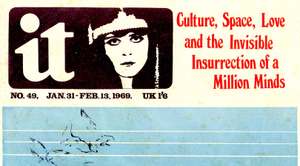
Barry Miles and International Times: ‘The invisible insurrection of a million minds’

International Times

Last week I went to a panel discussion on magazines; although I took notes on all three speakers, I ended up with loads from the talk by Barry Miles, co-founder of 60s underground paper International Times (Wikipedia). He talked at length about I.T.’s genesis, launch party and development, which I found fascinating. Here are my full notes. Bear in mind these notes were scribbled at pace, so apologies for any errors/omissions.

On the genesis of I.T.:

“We put on a poetry reading at the Albert Hall in 1965. It cost £400 to hire, then another £100 an hour. And bear I mind, I earned £10 a week at this time, and we had only 9 days to publicise it. But we sold the tickets and it went ahead, and we saw that we, youth culture, were a real constituency. It’s very, very difficult now to imagine how straight England was, even in the mid 60s. It was a very black and white world then.”

On I.T. being totally counter to Fleet street and established media:

“The idea of anyone from our community writing for the Guardian or the Times was inconceivable. None of the papers had any popular music coverage in those days. Our group of people needed somewhere to express themselves, so in early 1966, Hoppy (John Hopkins) and I started to put it together. We got the guy who’d been editor of Peace Times for CND, to help, too. He’d gotten freaked out and left London and gone to live in the countryside, but we got him to come back.”

On I.T.’s launch:

“We had the launch party at the Roundhouse in Camden. It had been used for storing gin, and had been abandoned for seventeen years. It was just a big space with a balcony that was apparently unsafe. But it was ideal for IT. Soft Machine and The Pink Floyd played. I remember paying them – Pink Floyd got £15 because they had a light show, and Soft Machine got £12. Although they had a motorcycle on stage, so maybe that was a bit unfair.”

On how I.T. was written and distributed:

“I.T. wasn’t properly edited. It depended a lot on people bringing stuff in. It was the same with distribution – anyone could come in a grab 50 copies, and we just trusted them to bring the money back, and then they could get some more copies. By 1969, I.T.’s height, we were printing about 44,000 copies, and it was going out every two weeks or so, unless we’d been busted or something.”

How I.T. got into advertising and staved off financial collapse:

“The first few issues had a lot of serious articles by William Burroughs about the overthrow of the state. He used it as his platform to work out his ideas. And there was Ginsberg too. All the usual suspects. When we were running out of money, I was talking to Paul McCartney about it, and he said, ‘Well, you should interview me, then you’ll get ads from the record companies.’ And I thought, ‘hey, he might be on to something.’ So I interviewed him, and then George Harrison, and then the next week Mick Jagger called up, demanding to be interviewed too. And Paul was right, we got ads from the record companies.”

On I.T. and the community:

“We’d have these happenings on Tottenham Court Road. Lots of people would come down – The Beatles, Pete Townshend. He’d pay £20 or something on the door, becuase he knew it was going to I.T. It was a community paper, our community’s paper, so people put into it. I.T. was outside normal society in every respect.”

Notes from Dispense and Connect: On the past, present and future of magazines

100 ideas

Earlier this week, I went to Dispense and Connect at the Southbank Centre, an event that was part of its current ‘100 ideas’ season. It was a panel talk about magazines; given this vague, expansive topic the three panellists each set and answered their own questions. First up was Bice Curiger, editor of art mag Parkett; she basically talked about influences on her and the magazine; for my tastes, her talk was a bit dry and consisted mostly of references to obscure 70s German art titles. Maybe I’m a philistine 😉

Far more entertaining was speaker no 2., Sina Najafi, editor of NYC art and culture mag Cabinet. Sina talked about Cabinet’s ideas and ethos, and highlighted some of its most interesting stories. The magazine’s aim, he said, was to go “towards a new culture of curiosity. We’re interested in meandering as a process of curiosity.” One of the slides showed an image from Tristram Shandy (below) which illustrates a storyline taking a very sinuous path to go from A to B and reach its ‘conclusion’. Cabinet’s rather wonderful full piece on illustrations of narrative progress, ‘A Timelines of Timelines’ is archived on their site, here.
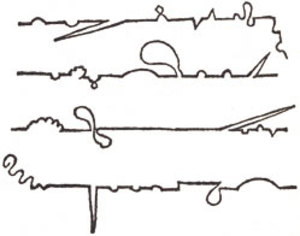
Tristram Shandy handwriting

Other story highlights from the magazine that Najafi talked about included a piece called “NATO as architectural critic”, which looked at the way NATO bombed Belgrade, in which they simply decided to target whichever buildings ‘looked’ like they should be important. Cabinet also reproduced drawings of the seven patterns Goats walk in when they’re high on acid, as discovered by the CIA in an experiment at Yale(!) A good sell, and next time pay day rolls around, I’ll certainly be grabbing myself a sub.

The third speaker was writer and editor Barry Miles, whohelped launch counter cultural mag International Times in the 60s. I.T.’s launch was “one of the two most revolutionary events
in the history of English alternative music and thinking. The I.T.
event was important because it marked the first recognition of a
rapidly spreading socio-cultural revolution” according to Soft
Machine’s Daevid Allen. (And yes, at Dispense and Connect, someone asked what the other event was, and according to Miles, no-one can remember).

Being a bit of a 60s obsessive, I found Barry’s talk completely enthralling, so it was his talk I took the most notes on. I’ll put up a full post of these later, rather than overwhelm this general round up with them. Suffice to say, Miles’ talk was hugely entertaining and full of tall tales. The point that he kept coming back to and stressing was that I.T. was “a community paper, our community’s paper. I.T. was outside normal society in every respect.” This was reflected in his reminiscence of the title’s genesis:

“We put on a poetry reading at the Albert Hall in 1965. It cost £400 to hire, then another £100 an hour. And bear I mind, I earned £10 a week at this time, and we had only 9 days to publicise it. But we sold the tickets and it went ahead, and on that night we saw that we, youth culture, were a real constituency. It’s very, very difficult now to imagine how straight England was, even in the mid 60s. It was a very black and white world then. The idea of anyone from our community writing for the Guardian or the Times was inconceivable. Our group of people needed somewhere to express themselves.”

Of course, these days, any mention of “community’ doesn’t make most media people think of magazines, but of the web – MySpace, social networks etc – and indeed, when asked by a member of the audience about I.T.’s relation to this, Miles’ reply was that “yes, I suppose in some way you could see I.T. as a kind of blog.”

Najafi, as editor of a currently published title, was far warier of the community approach; despite the fact that his magazine, Cabinet, has a lot of reader involvement projects (such as Cabinetlandia, the magazine’s own country where readers can buy land), he was wary of the potentially alienating and limiting factors of ‘community’. For him, I got the feeling it was the individual’s exploration of each issue’s cabinet of curiosities that took precedence, rather than any form of ‘group empowerment.’ Distance and the solitary pleasures of reading/thinking are as crucial as community, and given the web’s efficiency at forming the later, perhaps it’s no bad thing that 21st century magazines are rediscovering their power to inspire a good meander in territories of the former.


The importance of real things being nice things

Custom PC covers

In a previous post on bloggers vs mainstream media, I wrote that:

“When information is free and virtual, it’s important for real things to be nice things, to be good quality things, to be a guaranteed brilliant use of the reader’s very precious time.”

More and more I’m coming to think this really is the case; a lot of the praise for Tyler Brule’s recently launched Monocle magazine mentioned its use of four different paper stocks to create a really satisfying thing; when I look at the full price music I’ve bought in physical form recently, (as opposed to downloads from Emusic), it’s often been box-sets (this, this and this for instance), where the packaging, photos, liner notes etc are as important as the CD itself, which will of course be instantly ripped to MP3.

So with the mantra ‘REAL THINGS MUST BE NICE THINGS’ firmly in mind, we’ve been making some changes to Custom PC. There’s been an internal freshening up of the design, particularly the reviews section, to make it more appealing, but easily the most noticeable change is one seen only to subscribers: a special cover. Stripped of all the cover lines and blurbs, it really allows our excellent photography to stand out. Click on the picture above for an enlargement – although, of course, it looks and feels even better in real life.

Joost invites all gone – I wonder why?

The post title says it all – took a little over 24 hours, but my latest Joost invites are now all gone. The lucky recipients were:

* McGuyver
* Tony Jones of Compelling Content
* Alan Hussey
* Perry Taylor

When Joost next dole out some more invites, I’ll put a post up, same as before, so stay tuned.

I learned two things from this experiment:

1. Joost has phenomenal brand power; people are hugely interested in it, which is hardly surprising given the track record of the company’s founders. It’s interesting that it’s these previous projects and the rigmarole of the invites process which are being used to generate momentum/PR for Joost; it’s a start contrast to the way TV networks normally sell themselves, which is of course, on the basis of their content.

The main reason for this is that, as everyone who has received an invite from me finds out about 15 minutes after loading Joost up, there really isn’t a lot of content on there – certainly not that’s any good. Only the White Stripes and QOTSA interviews from Canadian TV have really held my interest.

I don’t think this is the only reason Joost is opting for a drip-drip-drip of info and invites; PR wise, the most successful company in the world right now is Apple, a company which generates huge media interest by opting for secrecy. It does make you wonder if Wired’s current cover story, ‘Get Naked And Rule the World‘ is a little off target. Given Apple and Joost’s approach, and of course the secrecy notoriously favoured by Google, do you really believe the following, from the article’s intro, is true?

“Smart companies are sharing secrets with rivals, blogging about
products in their pipeline, even admitting to their failures. The name
of this new game is RADICAL TRANSPARENCY, and it’s sweeping boardrooms
across the nation.”

2. The second fact I learned is that Google blog search is fantastic; I had comments responding to my post within 30 minutes – and I think, from the stats, that pretty much everyone found the post via Google (or via an existing bookmark) – not Technorati. Something for Technorati to be very worried about, I think.

Finally, a use for PCI-E 1x slots

Airpace card

If you’ve bought a new motherboard in the past year or so, as well as 16x PCI Express slots for hot new graphics cards, it’s probably also got 1x PCI-E slots. Aside from some high-end RAID cards and other assorted exotica, there’s not been anything useful for the masses to stick in these; well, no longer. I found Abit makes a WiFi card with a 1x PCI-E interface called the Airpace. I picked one up for my work PC (a Shuttle) from YoYoTech for £20; hardware wise, it’s great, absolutely tiny and a cinch to install – although it’s only 802.11g, not pre-N. The software is a little weird too; so far I’ve not actually needed to use the Abit disc, with WinXP picking the card up fine on its own… Still it’s worked well enough for me to write this post 🙂

Being a tourist at home

Stopping at St Paul's
Each issue of Custom PC is produced on a four week schedule, however, because of Easter and Christmas, every now and then we end up making a magazine in less time – these “three weeker” issues are always a bit mental, but the upside is that they create a few five week ones – and it’s the perfect time to take a bit of holiday. As a result, I’ve got all next week off, but since the Jesteress still has to go to work, I’m going to try being a tourist in my own city. So what’s on the agenda?

1. Going to see St. Paul’s. I ended up on a bus going past there a few days ago, and remembered I’ve never been inside. Time to set that straight.

2. The Hogarth show at Tate Britain. London’s big museums put on some fantastic shows, but they do tend to get very crowded, so seeing one while everyone else is at work will be fun. According to one of the freebie papers, there’s also a show at the Haunch of Venison by French artist Philippe Parreno; it contains video of a Victorian automaton, which I’d love to see.

3. Lots of reading. David Mitchell’s latest, Black Swan Green, has just come out in paperback, and I’ve also got Don Quixote on the go, plus a pile of other bits and pieces, including Michael’s Frayn’s The Human Touch, and one on the history of language entitled Empires of the Word.

4. Some more photography with my D40. According to the BBC Weather forecast, it’s going to be nice and sunny all week…